
The GCC Tomato Gap
LinkedIn Article 04-05-2026
Tomatoes are among the most consumed fresh products in the GCC, and among the most exposed to supply disruption.
Across the region, domestic production drops sharply between April and October, when summer conditions push cooling requirements beyond what most greenhouse systems can carry economically. During this period, supply relies heavily on imports.
This creates a recurring structural gap. Not a crisis, but a seasonal imbalance between local production capacity and demand.
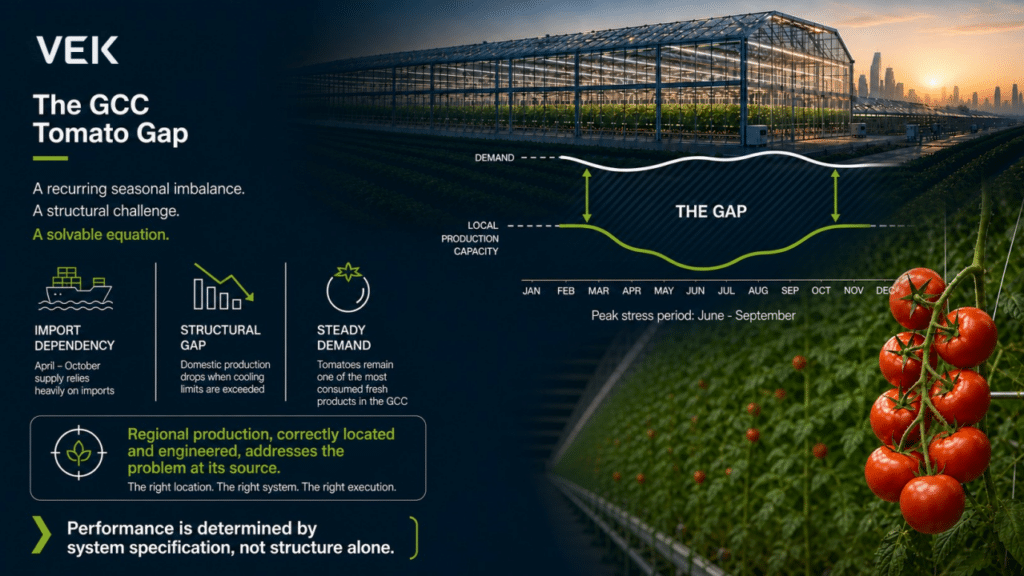
Recent supply chain disruptions have highlighted how exposed this gap becomes when imports are constrained. What has long been a predictable seasonal pattern becomes, under pressure, a structural vulnerability.
Three responses are typically considered:
Logistical adjustments to maintain import flows
Supplier diversification to reduce reliance on specific markets
Regional production expansion to reduce structural dependency
Only the third addresses the problem at its source.
This is where geography and system design must be considered together.
Much of the region’s investment to date has focused on expanding controlled-environment agriculture in the central Gulf. This has been a necessary step. However, the next phase is more nuanced. It is not simply about increasing capacity, but about ensuring that capacity performs during the months when conditions are most demanding.
Certain locations across the region offer structural advantages in this regard.
Inland regions within the UAE, such as Al Ain, operate under a markedly different climate profile to the coast. Lower humidity and greater diurnal temperature variation allow cooling strategies to function more efficiently, provided systems are engineered to reflect these conditions rather than generic design assumptions.
Across the wider region, similar patterns emerge. Parts of northern Oman share comparable inland characteristics, while southern Oman benefits from the khareef period, during which temperatures and evaporation rates are significantly reduced at the height of the Gulf summer.
These are not competing geographies. They are complementary components of a regional production system.
In addition, elevation plays a critical role. Higher-altitude locations can materially reduce thermal load, improve night-time cooling, and ease the burden on mechanical systems. When considered alongside coastal and inland dynamics, elevation becomes part of a broader design framework rather than a standalone advantage.
The implication is clear: the solution is not a single location or a single technology.
It is the intelligent alignment of geography, climate, and system design across the region.
The challenge, however, is not only where to build, but how.
Many greenhouse projects underperform not because of ambition, but because of misalignment. Systems are often specified using templates developed for entirely different climates. High-specification glasshouses designed for temperate environments struggle under Gulf cooling loads. Lower-specification systems cannot maintain stability when external temperatures exceed operational thresholds.
In both cases, capital is deployed, but performance does not follow proportionally.
What matters is specification discipline from the outset:
systems aligned with local energy and water conditions
cooling strategies designed for real operating environments, not design-day assumptions
water and nutrient systems engineered as closed loops
operational readiness built into the facility from day one